
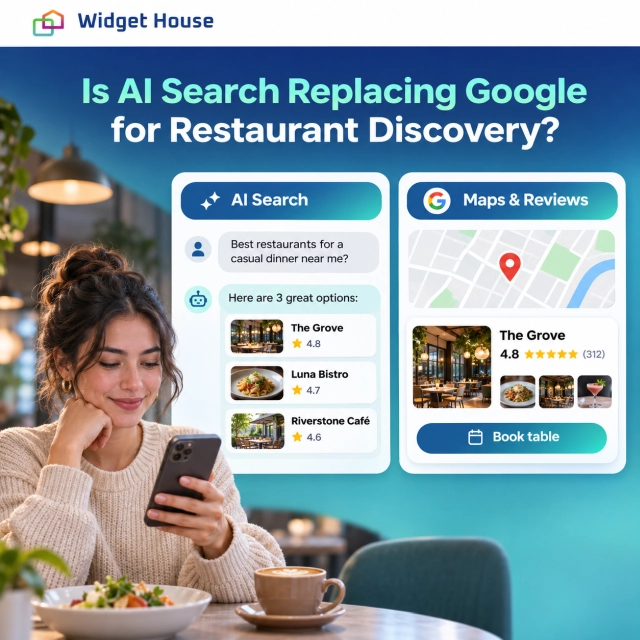
Restaurant discovery is becoming conversational. A diner can ask ChatGPT for a quiet date-night restaurant with vegetarian options, ask Google Maps for a café with outdoor seating and short wait times, compare real-time reservation slots, and move from recommendation to booking without repeating the search.
That shift is real. But the claim that AI search is simply replacing Google is too neat for the evidence.
In 2026, AI is adding a new discovery layer while Google remains the dominant local data, verification, navigation, and action infrastructure.
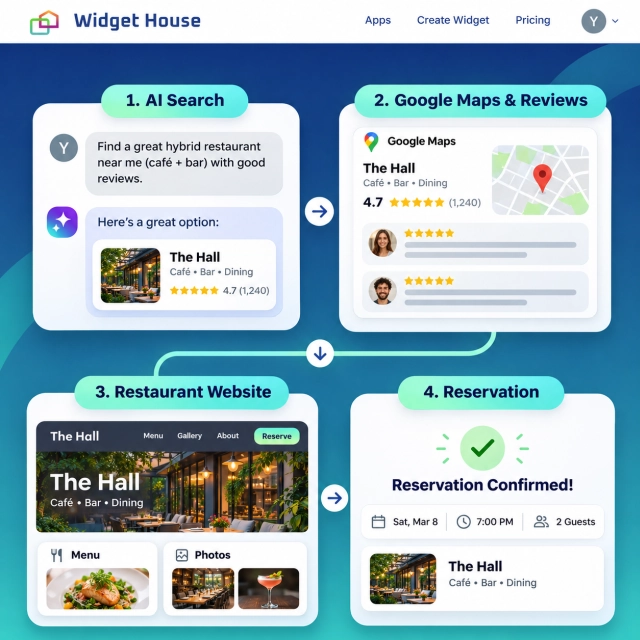
The more accurate model is not AI versus Google. It is a hybrid journey in which diners use AI to describe what they want, Google and Maps to verify places and logistics, reviews and social content to reduce uncertainty, and restaurant or reservation platforms to complete the action.
“AI Search vs. Google” Is Becoming a False Binary
The most important development is that Google is not standing outside the AI transition.
Standalone assistants such as ChatGPT can search the web, use approximate location, recommend restaurants, refine options through follow-up questions, and show reservation availability from supported providers. OpenAI added restaurant reservation search with OpenTable, Resy, and Yelp in 2026, with availability varying by provider and location.
At the same time, Google is placing Gemini directly inside Search and Maps. Ask Maps can handle conversational restaurant queries, personalize suggestions, analyze reviews, photos, and menus, and help users order food in supported locations.
That means a diner who says “I used AI instead of Google” may still be using Google data through AI Mode or Ask Maps. Conversely, a diner who opens Google Maps may now be using an AI-driven recommendation interface rather than a traditional ranked list.
ChatGPT and similar assistants
Best suited to conversational planning, multi-constraint questions, comparison, follow-up refinement, and increasingly reservation discovery.
AI Mode and Ask Maps
Combine conversational search with Google’s map, place, review, menu, hours, directions, availability, and local-action infrastructure.
Sources: OpenAI - Searching the web with ChatGPT; OpenAI - ChatGPT release notes; Google - Ask Maps and Immersive Navigation.
What the 2026 Data Actually Shows
AI adoption is rising quickly, but different studies measure different behaviors. “Used AI at least once,” “first discovery channel,” and “website referral traffic” are not interchangeable metrics.
| Finding | What it suggests | Important limitation |
|---|---|---|
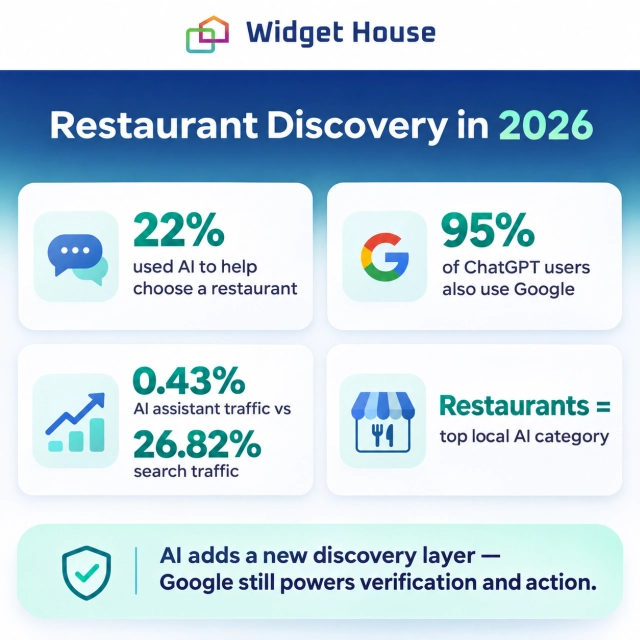
| 22% of U.S. consumers said they had used an AI tool such as ChatGPT or Gemini to help choose a restaurant. | AI is already a meaningful restaurant-discovery behavior, not a fringe experiment. | DoorDash surveyed 3,001 U.S. consumers in March 2026; the result measures any use, not exclusive or primary use. |
| Toast found word of mouth at 38%, in-person discovery at 30%, Facebook at 27%, map apps at 18%, and search-engine results at 16%. | Restaurant discovery remains fragmented and multi-channel; no digital surface fully controls the journey. | The survey asked how people discovered restaurants and allowed multiple pathways; it did not isolate AI as a separate category. |
| Yext reported that 47% of U.S. adults had used AI for local search in the previous month, with restaurants the highest category at 52%. | AI local discovery may be entering habitual use, especially for high-intent categories such as dining. | This is a vendor-commissioned, self-reported survey; question wording and category definitions differ from the DoorDash and Toast studies. |
| Similarweb reported that 95% of ChatGPT users also used Google, unchanged after substantial AI growth. | The audiences overlap substantially; this alone does not measure substitution in individual searches. | Audience overlap does not show which tool was used for a specific restaurant decision. |
| In Ahrefs’ September 2026 traffic snapshot, AI assistants generated 0.43% of tracked traffic, versus 26.82% from search. | Direct AI referral traffic remains far smaller than traditional search traffic. | This is cross-industry website traffic and misses zero-click actions, map activity, branded searches, phone calls, directions, and bookings completed inside other platforms. |
The apparent contradictions disappear once the metrics are separated. Many people may use AI during the decision process while still opening Google, Maps, a restaurant website, Instagram, Yelp, OpenTable, or a delivery app before acting.
Pew Research adds another caution: 60% of U.S. adults say they read AI summaries at the top of search results, but earlier Pew research found only 6% of those who encountered AI summaries trusted them “a lot.” Exposure is not the same as unquestioning reliance.
Sources: DoorDash 2026 Restaurant Industry Trends Report; Toast - How Guests Discover New Restaurants in 2026; Yext 2026 Consumer Search Behaviors; Similarweb - Is AI Replacing Search?; Ahrefs - AI vs. Search Traffic Analysis; Pew Research Center - Americans and AI 2026; Pew Research Center - Trust in AI summaries.
Why Google Is Still Difficult to Replace
Restaurant discovery depends on more than producing a persuasive recommendation.
Google Maps combines place identity, location, distance, directions, opening hours, photos, menus, reviews, live conditions, phone calls, website links, reservations, and navigation. Google reported more than two billion monthly Maps users, 250 million businesses and places, 500 million annual contributors, and roughly 100 million map updates per day.
That infrastructure gives Google several durable advantages:
- Fresh local data: hours, temporary closures, routes, traffic, availability, and user-contributed updates.
- Geographic intent: distance, travel time, neighborhoods, routes, and “near me” context.
- Large-scale review evidence: Google said Maps users published more than one billion helpful reviews in 2025.
- Immediate action: directions, calls, orders, reservations, saves, sharing, and navigation.
- Habit: Maps is already installed and frequently used at the moment a diner is ready to go somewhere.
AI assistants can synthesize restaurant information, but they often depend on underlying sources that Google, reservation networks, delivery marketplaces, restaurant websites, directories, and review platforms maintain.
Sources: Google Maps: 20 years and 20 features; Google - New ways we’re protecting businesses on Maps.
Where AI Search Is Genuinely Better for Diners
AI is strongest when the diner’s need is too nuanced for a short keyword.
Occasion-based discovery
“Find a relaxed anniversary dinner that feels special but is not formal.” AI can interpret the occasion, mood, budget, and context together.
Multiple constraints
Dietary needs, noise level, outdoor seating, children, parking, travel time, price, opening hours, and reservation availability can be combined in one request.
Conversational refinement
A diner can say “make it cheaper,” “closer to the theater,” or “only show places with late reservations” without rebuilding the query.
Cross-source synthesis
AI can summarize menus, descriptions, review themes, photos, neighborhood context, and reservation inventory into a shortlist.
Planning and coordination
The assistant can consider a route, event, hotel, meeting location, party size, or previous preferences instead of treating the restaurant as an isolated result.
Action inside the answer
ChatGPT can show restaurant availability from OpenTable, Resy, or Yelp, while Ask Maps can increasingly support ordering and other multi-step actions.
These advantages explain why AI can gain influence much faster than its referral-traffic share suggests. A diner may receive the shortlist from AI but complete the journey through Google Maps, a reservation provider, or a direct branded search.
OpenTable offers an early commercial signal: the company reported that its integrations with major AI and search platforms drove 17 times more seated diners year over year, and that those diners spent 20% more on average than diners from other channels. Those figures are vendor-reported rather than independent market measurements, but they show why reservation platforms are investing heavily in AI distribution.
Sources: OpenAI - ChatGPT release notes; Google - Ask Maps food ordering; OpenTable 2026 product launch.
The Emerging Restaurant Discovery Funnel
The journey is becoming a loop across several surfaces rather than a clean sequence controlled by one platform.
| Stage | Likely leading surfaces | What the diner needs |
|---|---|---|
| Inspiration | AI assistants, social media, word of mouth, Google Explore | Ideas matched to occasion, cuisine, mood, budget, and group needs |
| Shortlist | ChatGPT, AI Mode, Ask Maps, OpenTable, Yelp, delivery platforms | A manageable set of relevant choices and an explanation of why each fits |
| Verification | Google Maps, reviews, menus, restaurant website, Instagram and TikTok | Freshness, credibility, food and atmosphere evidence, dietary details, price, and logistics |
| Action | Maps, restaurant website, OpenTable, Resy, Yelp, delivery platforms | Reservation, order, directions, call, or a clear decision to visit |
| Post-visit | Google Reviews, social media, loyalty apps, email and messaging | A simple way to review, share, return, or recommend |
Yext’s 2026 research supports the verification layer: more than 93% of surveyed AI users took an additional step before acting. Among surveyed AI users, 62% searched Google, 58% visited the business website, and 52% clicked sources cited by the AI response.
In other words, a recommendation is not the same as a completed reservation. Restaurants still need to survive the verification step.
Forecast: What Is Most Likely to Happen Through 2029?
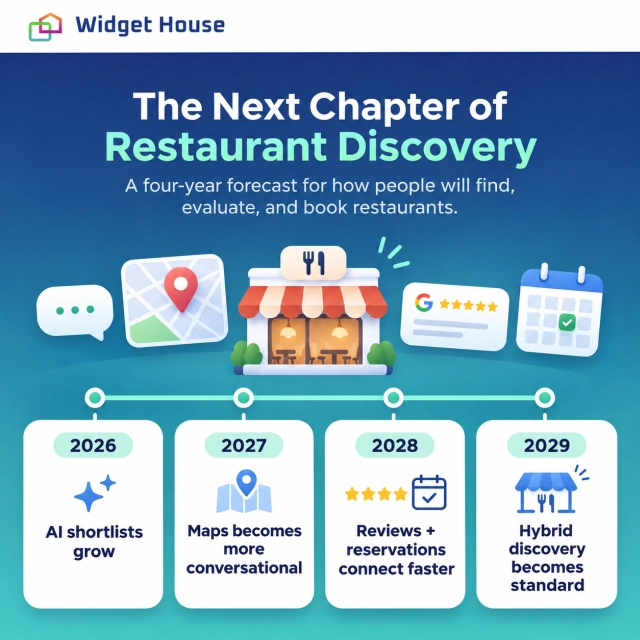
The following forecasts are editorial inferences based on the adoption, product, traffic, and consumer-behavior evidence above. They are not guarantees or published platform roadmaps.
| Forecast | Confidence | Why |
|---|---|---|
| AI becomes a standard restaurant-shortlisting interface. | High | Consumer adoption is already material, and major search, maps, delivery, and reservation products are adding conversational discovery. |
| Google becomes more AI-native rather than being displaced. | Very high | Google is embedding Gemini into Search and Maps while retaining unmatched local data, navigation, reviews, and action infrastructure. |
| Standalone assistants gain the most share in complex, occasion-based queries. | High | Natural-language assistants are strongest where the diner has several constraints and wants explanation or refinement. |
| Simple “near me” utility queries remain heavily Maps-led. | High | Distance, live hours, directions, traffic, and navigation are central to these decisions. |
| More reservations and food orders begin or finish inside AI interfaces. | High | ChatGPT, Ask Maps, OpenTable, and delivery partners are already connecting recommendations to live inventory and transactions. |
| AI referral traffic remains a poor measure of total AI influence. | Very high | AI can trigger branded search, Maps visits, directions, calls, app opens, and third-party reservations without a direct website referral. |
| Standalone AI fully replaces Google/Maps for restaurant discovery by 2029. | Low | Current behavior shows strong platform overlap and continued verification, while Google is absorbing AI features into its own local ecosystem. |
The likely winner is not one search box. It is the platform that connects the best recommendation to the freshest evidence and the easiest action.
What Restaurants Should Do Now
The practical response is not to abandon Google or chase a separate set of mysterious “AI ranking factors.” It is to make the restaurant easy to understand, verify, and transact with across every surface.
1. Keep Google Business Profile accurate
Maintain categories, hours, address, phone, menu links, reservation links, attributes, photos, and temporary changes. AI cannot compensate for inconsistent source data.
2. Publish a crawlable, current menu
Use clear HTML where possible, not only image files or inaccessible PDFs. Include prices, dietary information, cuisine, location, hours, and reservation details.
3. Build a healthy review signal
Earn genuine, recent reviews and respond professionally. Review recency, rating, count, and sentiment influence verification even when AI created the initial shortlist.
4. Maintain strong photos and social proof
Diners evaluate dishes, atmosphere, crowd, outdoor space, special occasions, and authenticity visually. Keep Maps, the website, and social profiles consistent.
5. Reduce booking and ordering friction
Keep live availability, reservation providers, direct booking links, order links, phone numbers, and directions working across mobile and desktop.
6. Distribute accurate data to major platforms
Restaurant websites, Google, OpenTable, Resy, Yelp, delivery services, and relevant directories can all become source material or action layers for AI discovery.
7. Measure more than AI referrals
Track AI referral sessions, but also branded search, Maps actions, calls, direction requests, reservation-source data, and changes in direct traffic.
8. Avoid “AI keyword” gimmicks
Do not manufacture unnatural review phrases or fill pages with question variants purely for assistants. Accurate entities, useful content, and strong real-world reputation are more defensible.
Does the Restaurant Website Still Matter?
Yes-but its role is shifting from discovery destination to verification and conversion layer.
Some diners will book or order without visiting the website. Others will arrive after AI has already framed the restaurant as a good match. Those visitors are more qualified, but they also expect immediate confirmation: the right menu, credible reviews, current photos, clear location details, and an obvious reservation or order path.
The website should answer the question the recommendation created: Can I trust this place for this specific occasion?
A Small but Useful Website Opportunity
When an AI-referred diner visits the restaurant website, visible customer proof can help confirm the recommendation. Placing a compact Google rating near a reservation button or a small review carousel near the menu can make that verification easier.
This is a conversion tactic, not a guaranteed AI-ranking tactic. A product such as the Widget House Google Reviews widget can help display current social proof without turning the website into a custom review-integration project.
Preview a Google Reviews widget for your restaurant website and explore available layouts.
Frequently Asked Questions
Are people already using ChatGPT to find restaurants?
Yes. DoorDash’s 2026 U.S. survey found that 22% of consumers had used an AI tool such as ChatGPT or Gemini to help choose a restaurant. The share varies by study because surveys use different definitions and time windows.
Will ChatGPT replace Google Maps for restaurants?
A complete replacement is unlikely in the near term. Google Maps combines location, directions, live place data, reviews, menus, contributor updates, and navigation, while also adding its own AI interface through Ask Maps.
Do restaurants need a separate AI SEO strategy?
Restaurants need an AI-aware discovery strategy, but not a collection of unproven tricks. Accurate business data, crawlable menus, fresh reviews, useful website content, strong photos, and working reservation integrations support visibility and conversion across both AI and traditional platforms.
How can a restaurant measure AI-driven discovery?
Measure direct AI referrals where available, but also watch branded search, direct traffic, Google Business Profile actions, calls, direction requests, reservation-provider source data, and customer surveys. AI influence often appears as an indirect action rather than a clean referral.
Will reviews become less important if AI summarizes them?
No. AI summaries depend on underlying evidence, and consumers frequently verify recommendations. Reviews continue to provide rating, recency, sentiment, detail, and credibility during the decision process.