
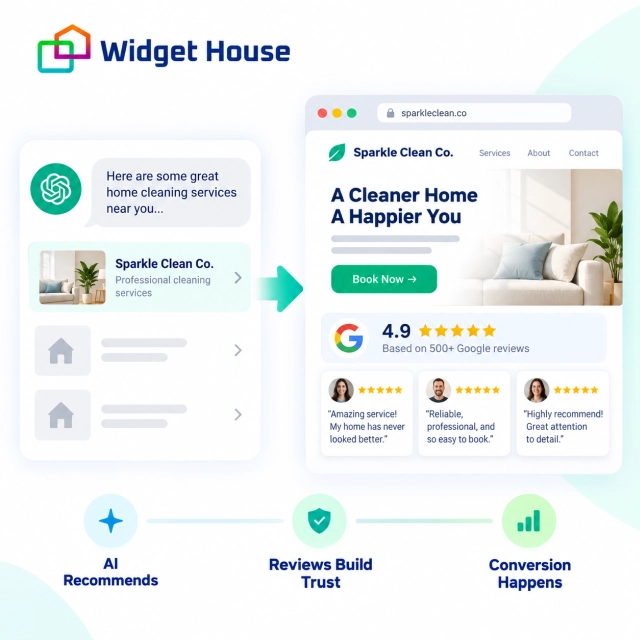
AI can now do much of the early research that used to require several searches, comparison tabs, and directory pages. A customer can ask for the best option for a specific need, get a shortlist, and reach a business website faster than before.
But faster discovery does not remove the final question:
“Can I trust this business enough to contact it, book it, or buy from it?”
That is the trust gap between an AI recommendation and a conversion. Google Reviews still matter because they give potential customers something an AI-generated recommendation alone cannot fully replace: visible feedback tied to real customer experiences on a recognizable external platform.
Google itself is carrying those signals into AI-native search experiences. Its AI Mode can show local place cards with ratings, reviews, opening hours, and other business information. The interface is changing, but the need for review evidence is not disappearing.
AI Is Becoming a Discovery Layer — Not the Final Trust Layer
Search is moving from “find me ten links” toward “help me narrow the options.” That changes the first step of the journey more than the last one.
AI summaries and conversational search are already part of normal search behavior. In a 2026 Pew Research Center survey, six-in-ten U.S. adults said they read AI summaries at the top of search results.
Google is also making AI search more actionable. For local places such as restaurants, salons, and stores, Google says AI Mode can surface details such as ratings, reviews, opening hours, live busyness, and ways to call or get directions.
This is important for businesses because it means AI discovery is not replacing reputation signals. In some cases, it is moving those signals closer to the recommendation itself.
To understand how those signals affect organic visibility after the visitor reaches your site, read Do Google Reviews on Your Website Help SEO?
The Trust Gap Starts After the Recommendation
A recommendation can create interest without creating enough confidence to act.
Imagine a visitor asks an AI search tool:
“Who is a good emergency plumber near me that responds quickly and has transparent pricing?”
The AI may return several businesses, explain why they appear relevant, and provide links. That reduces the effort required to build a shortlist.
But the customer may still want to know:
- Have real customers used this company recently?
- Do people mention fast response times?
- Are pricing experiences generally positive?
- Do negative reviews reveal a recurring problem?
- Does the business look as credible on its own website as it did in the recommendation?
There is evidence that people do not automatically treat AI-generated search information as unquestionable. In a 2025 Pew Research Center survey of Americans who had encountered AI search summaries, 53% said they had at least some trust in the information, but only 6% said they trusted it a lot; 46% said they had little or no trust.
That does not mean users reject AI recommendations. It means recommendation and verification remain different stages.
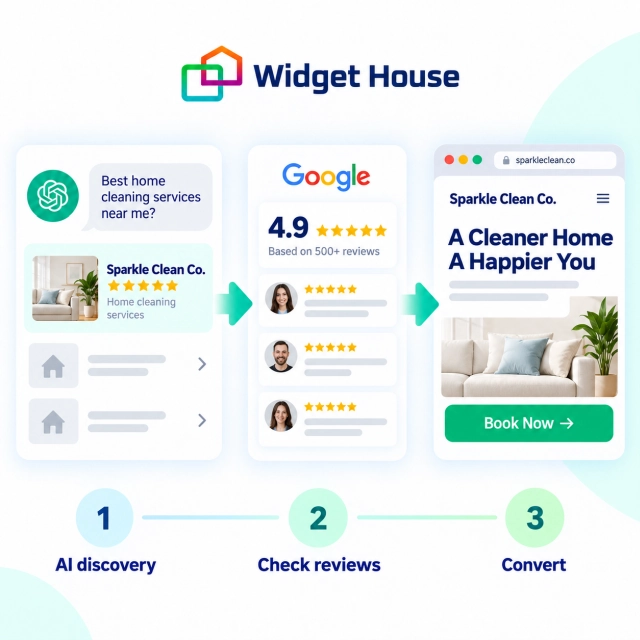
Recommendation → Verification → Conversion
The modern customer journey can become shorter without becoming simpler.
| Stage | Main job | Customer question |
|---|---|---|
| AI recommendation | Discovery and shortlist creation | “Which options fit what I need?” |
| Google Reviews | Independent-looking social proof and experience signals | “What happened when other people chose this business?” |
| Business website | Fit, offer, reassurance, and next action | “Is this right for me, and what do I do next?” |
The stages can overlap. Google may show reviews inside an AI experience, and an AI assistant may summarize reputation information. But once a user reaches your website, you control the conversion environment.
That is where visible review proof can prevent the page from feeling like a downgrade from the recommendation that brought the visitor there.
Want to see how Google reviews can support the final decision on your own site? Use the Widget House Google Reviews Widget builder below to preview a review layout before publishing it.
Why Google Reviews Still Matter After AI Discovery
AI can synthesize information. Reviews expose the underlying customer experiences that make a reputation believable.
They come from a platform customers already know
Google Search and Maps show review scores, review counts, and review content for local businesses. Visitors understand that the feedback exists outside the business’s own marketing pages.
They answer questions marketing copy usually cannot
A review may mention response time, staff behavior, product quality, installation, cleanliness, delivery, pricing, or how a problem was handled. Those details can reduce uncertainty at the exact point a customer is deciding.
Recent feedback signals that the business is active now
A website claim can remain unchanged for years. Recent reviews provide a more current view of what customers are experiencing.
Multiple voices are harder to reduce to one marketing claim
One testimonial tells one story. A broader review history lets visitors see recurring themes across different customers and situations.
Research on online reviews also shows why visible feedback can matter once a customer reaches a purchase decision. Northwestern University’s Medill Spiegel Research Center found that, in its product-review data, purchase likelihood for a product displaying five reviews was 270% greater than for a product displaying none.
That result should not be translated into “five Google reviews increase website conversion by 270%.” The study examined product-review behavior in a specific research context. The useful lesson is broader: visible customer feedback can materially change how people evaluate an offer.
For a direct comparison of these two forms of social proof, see Google Reviews Widget vs. Manual Testimonials.
The Website Is Where the Recommendation Has to Prove Itself
The more specific the AI recommendation, the more obvious a mismatch becomes when the visitor lands on the website.
If an AI tool recommends a company for same-day HVAC repair, the landing experience should quickly confirm that the company actually offers that service, serves the visitor’s area, and gives them a clear next step.
Reviews can reinforce that alignment.
“This business appears to fit your need.”
The AI layer helps with relevance, discovery, and comparison.
“Here is the proof, the offer, and the next step.”
The page should validate the service, demonstrate customer experience, and make action easy.
A trust gap often appears when the website is weaker than the discovery experience. Common examples include:
- the service mentioned in the recommendation is difficult to find on the page;
- the website makes broad claims but provides no customer proof;
- reviews are hidden on a separate page while the conversion CTA asks for immediate commitment;
- the business has a strong Google rating but does not surface that reputation near important website decisions;
- the page looks outdated or inconsistent with the business information shown in Search or Maps.
AI Recommendations and Google Reviews Do Different Jobs
It is more useful to think of AI and reviews as complementary decision tools than as competing sources.
| Dimension | AI recommendation | Google Reviews |
|---|---|---|
| Primary value | Synthesis, comparison, and discovery | Customer experience and social proof |
| Information style | Summarized and contextualized | Individual customer feedback plus rating history |
| Best question answered | “What should I consider?” | “What was it actually like for customers?” |
| Business control | Limited; depends on the AI system and its sources | Limited over the source; the business can respond but should not manipulate feedback |
| Role on your website | Usually the acquisition source or referral context | Visible reassurance close to the conversion decision |
How to Use Google Reviews to Convert AI-Referred Visitors
The goal is not to show as many reviews as possible. It is to show the right proof at the moment uncertainty is highest.
1. Put review proof near high-intent actions
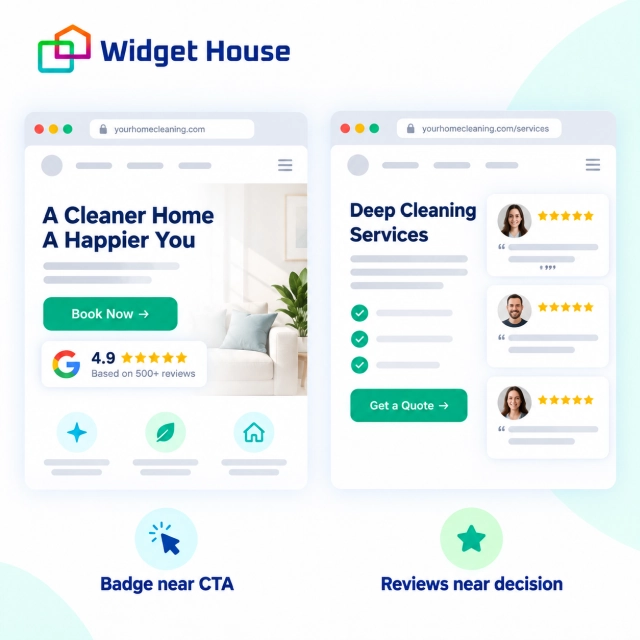
Show rating and review signals close to booking forms, pricing blocks, product CTAs, quote requests, or contact buttons. The closer the user is to commitment, the more useful reassurance becomes.
2. Match reviews to the page
A service page is stronger when the visible reviews mention that service. A location page is stronger when the review context is relevant to that location or customer need.
3. Choose the layout for the decision moment
Use a compact Badge when you need a quick trust signal, a Slider or Carousel when reviews should support another section, and a Grid when visitors are actively exploring more feedback.
4. Keep the page easy to scan
Do not turn every page into a wall of review cards. A focused review section can reduce uncertainty without competing with the product, service, or primary CTA.
5. Keep the page useful without the widget
Your service description, pricing context, location information, and conversion path should remain understandable even if third-party content is delayed or unavailable.
When the Trust Gap Is Usually Largest
Review proof tends to matter most when the customer perceives meaningful risk in choosing the wrong option.
Local services
Home services, healthcare, beauty, automotive, legal, and other local categories often require customers to trust a provider before they have any direct experience with them.
Unfamiliar brands
AI can introduce businesses the customer has never heard of. Reviews help establish whether that unfamiliar name has a credible record of serving real customers.
Higher-consideration decisions
The more expensive, disruptive, or difficult to reverse a decision feels, the more likely customers are to look for additional evidence before acting.
Claims that sound easy to make
“Fast,” “reliable,” “friendly,” and “high quality” are common marketing claims. Reviews become more useful when customers independently describe the same qualities.
Do Not Try to Manufacture the Trust Signal
The value of reviews depends on customers believing that the feedback reflects genuine experience.
Google’s Business Profile content policy prohibits fake engagement and review manipulation, including paid or incentivized reviews, selectively soliciting positive feedback, and pressuring customers to include specific content.
For the website, avoid a different kind of manipulation: presenting only a tiny set of perfect comments in a way that implies they represent the full review history.
Instead:
- collect genuine feedback consistently;
- respond professionally to positive and negative reviews;
- show enough context for visitors to understand where the reviews come from;
- use review layouts to make feedback easier to evaluate, not to disguise it;
- measure whether review placement improves engagement and conversion rather than assuming it will.
Final Verdict: AI Can Shorten Discovery, but Reviews Still Help Close the Decision
AI is changing how customers find businesses. It is not eliminating the need to verify them.
An AI recommendation can be extremely useful at the top of the decision process. It can understand a complex request, compare options, summarize information, and point the customer toward businesses they may never have discovered through a traditional query.
But the final conversion still depends on confidence.
AI recommendation:
“This business is worth considering.”
Google Reviews:
“Here is what customers actually experienced.”
Website:
“Here is why we fit your need — and what to do next.”
That is why Google Reviews still close an important trust gap. They connect machine-assisted discovery with human evidence at the point where a visitor is deciding whether to act.
Frequently Asked Questions
Can AI recommendations replace Google reviews?
No. They serve different functions. AI can help users discover and compare businesses, while reviews provide individual customer experiences that help people validate the recommendation before acting.
Do Google reviews influence AI recommendations?
It depends on the AI system and the query. Google has confirmed that AI Mode can display ratings and reviews for local places, but Google does not publish a simple rule saying that a specific rating or review count guarantees an AI recommendation.
Should I still show Google reviews on my website if they already appear in Search or Maps?
Yes, when they help the visitor make a decision on the page. Showing relevant reviews near pricing, booking, contact, or purchase actions can keep the social proof inside the conversion journey instead of requiring the visitor to leave the site to verify your reputation.
What is the best Google Reviews layout for AI-referred visitors?
There is no single best layout. Use a Badge for quick reassurance near a CTA, a Slider or Carousel when reviews support another section, and a Grid when visitors need to explore more feedback before deciding.
How many reviews should I display on the page?
Show enough reviews to answer the visitor’s likely concerns without overwhelming the page. Relevance, recency, and placement are usually more useful than simply maximizing the number of visible review cards.