
Google Reviews used to work in a familiar way: check the star rating, scan a few recent reviews, search for a specific complaint or compliment, and decide whether the business looks trustworthy.
That experience is changing.
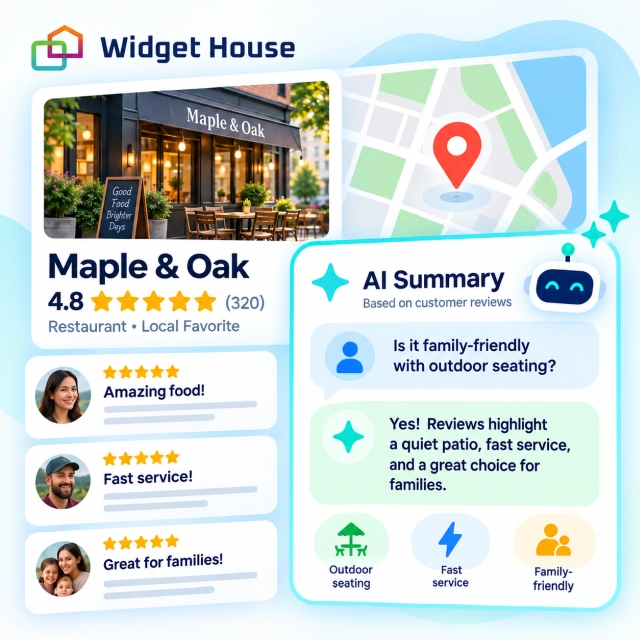
Google Maps can now use Gemini to summarize what reviewers say about a place, answer detailed questions, and help users compare businesses without requiring them to read dozens of individual reviews. In March 2026, Google expanded this idea further with Ask Maps, a conversational experience that can answer complex questions about places and make recommendations using Maps data. Google says Ask Maps analyzes information from more than 300 million places, including reviews contributed by a community of more than 500 million people.
Source: Google Maps: Ask Maps and immersive navigation
If you want a broader view of how Google Reviews fit into AI-assisted local discovery across Google AI Mode, Maps, and ChatGPT, see our guide Google Reviews and AI Search: How Local Business Discovery Is Changing in 2026.
For businesses, that creates an important shift: your reviews are no longer useful only when someone opens the Reviews tab. The experiences customers describe can also become part of the AI-generated layer that helps another customer understand your business before they read a single review in full.
What Are AI Review Summaries in Google Maps?
AI review summaries are designed to compress large amounts of customer feedback into something a user can understand quickly.
Google introduced Gemini-powered review summaries in Maps to help people understand what customers like about a place without reading every individual review. Gemini can also answer specific questions about a business, such as whether a restaurant has outdoor seating or whether a place has a quiet atmosphere. Google says these features combine Gemini's reasoning and summarization capabilities with information about places and insights from the Maps community.
Source: Google Maps updates: Gemini arrives
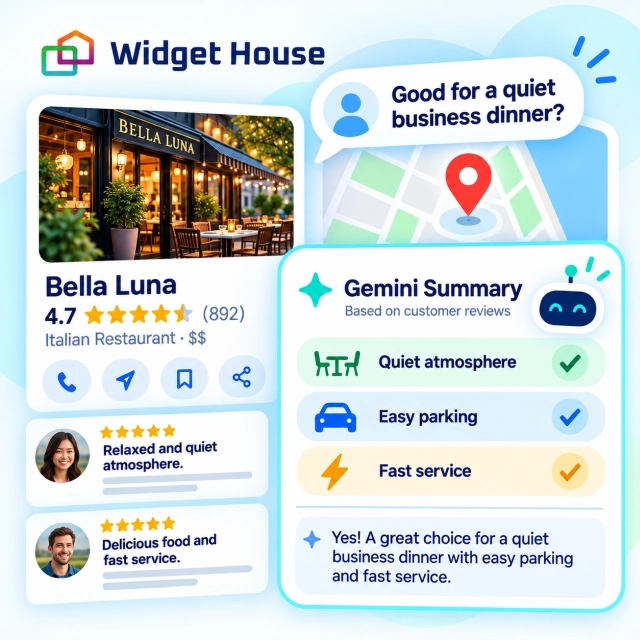
In 2026, this direction has become even more conversational. Instead of opening a business profile and manually searching through reviews, a customer can ask Maps a question such as:
“Is this restaurant good for a quiet business dinner?”
“Which hotel nearby has easy parking?”
“Where can I get coffee without waiting in a long line?”
“Is this gym beginner-friendly?”
“What do people like most about this salon?”
Ask Maps is built for questions like these. Google describes it as a way to move from searching through multiple places and pieces of information to simply asking Maps what you need to know. The system can draw on Maps data, community contributions, and the user's context to produce a more direct answer.
Source: Google Maps: Ask Maps and immersive navigation
That does not mean every Maps result contains the same AI-generated review summary. Features can differ by market, device, query, business category, language, and rollout stage. But the direction is clear: Google is increasingly turning large amounts of local information into concise answers that help people evaluate places faster.
How Gemini “Reads” Customer Reviews
Google does not publish a formula explaining exactly how Gemini selects review statements, weighs individual reviews, or decides which themes deserve the most attention.
That distinction matters.
What Google does document is how it already extracts recurring information from customer reviews elsewhere in Maps.
Place Topics are based on reviews of a business and are designed to surface the main themes customers mention. Google says they are generated from concise information and keywords highlighted by reviewers and may reflect the prevalent sentiment of the underlying reviews.
Review snippets similarly surface frequently mentioned words and phrases from Google reviewers. These snippets are selected algorithmically, and what appears can vary across devices, platforms, languages, and locations.
Source: Google Business Profile Help: Understand your Business Profile on Google
This gives us a useful way to think about review content without pretending we know Gemini's internal ranking logic.
Consider two sets of reviews for the same restaurant.
Generic praise
“Great place!”
“Loved it.”
“Five stars.”
“Amazing!”
Specific experience
“The patio was quiet even on Friday evening.”
“They had several gluten-free options.”
“Service was quick before our show.”
“The staff was great with our kids.”
Both sets may be positive. But the second contains much more information about the actual experience.
That does not prove Gemini rewards detailed reviews or gives them a ranking advantage. Google has published no such rule. It simply means that specific customer experiences provide more concrete information that can potentially contribute to themes, snippets, summaries, or answers when relevant.
What Customers See Before They Open Individual Reviews
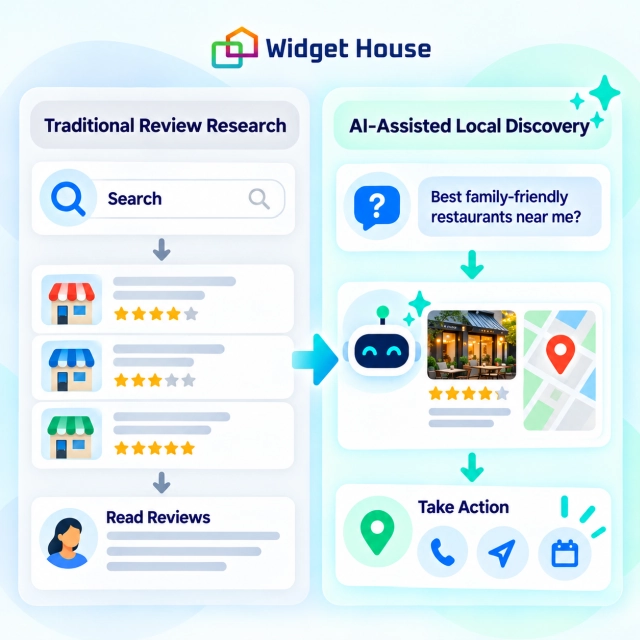
The traditional review journey required work. AI can compress several of those steps.
A customer might open several businesses, compare their star ratings, read reviews from each one, search for particular phrases, look at photos, and then return to the map.
A customer can now ask a detailed question and receive an answer or shortlist that already incorporates information available in Maps. Ask Maps can also personalize recommendations using context such as places the user has previously searched for or saved.
Source: Google Maps: Ask Maps and immersive navigation
Search →
Business Profile →
Review list →
Manual comparison
Question →
AI answer →
Shortlist →
Verification →
Action
Individual reviews have not disappeared. Users can still open a Business Profile and read the underlying feedback themselves. Google explicitly keeps individual reviews accessible even when features such as Place Topics help organize the information.
Source: Google Business Profile Help: Understand your Business Profile on Google
But AI can increasingly become the first interpretation layer between hundreds of individual customer experiences and the person making a decision.
This behavior is becoming familiar beyond Maps as well. Pew Research Center reported in June 2026 that 60% of U.S. adults say they read AI summaries at the top of search engine results. Among adults ages 18–29, that figure rises to 72%. The Pew research is about search summaries rather than Google Maps specifically, but it shows how quickly AI-generated summaries are becoming a normal way for Americans to consume information online.
Source: Pew Research Center: Americans and AI 2026
For local businesses, that matters because customers are becoming increasingly accustomed to receiving a synthesized answer first and investigating the underlying sources second.
Why Review Content Matters More Than Just Star Rating
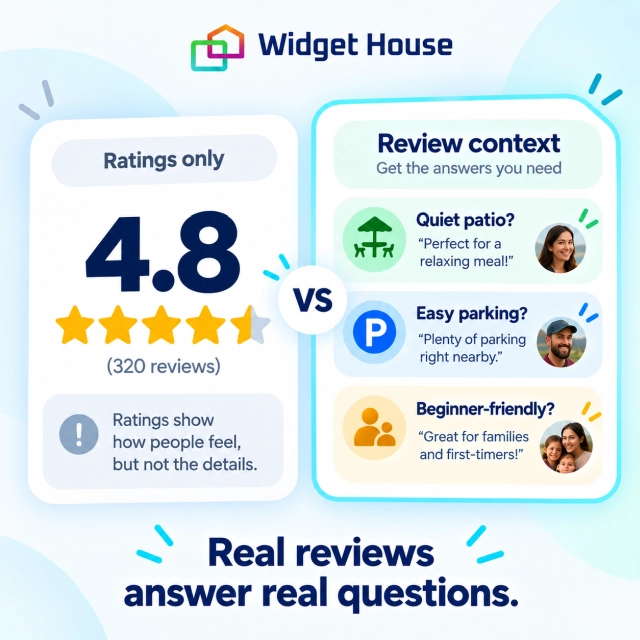
A rating tells someone how customers felt. The review text helps explain why.
A 4.8-star rating cannot tell a customer whether a hotel has quiet rooms, whether an HVAC company arrives on time, whether a dentist is good with anxious patients, or whether a restaurant works well for large groups.
Those details live inside individual experiences.
Google's own Maps features demonstrate this difference. Place Topics are created from themes in customer reviews, while review snippets highlight commonly mentioned words and phrases. Gemini-powered Maps experiences can go further by helping users ask specific questions about places.
Source: Google Business Profile Help: Understand your Business Profile on Google
This becomes particularly important as local queries become more conversational.
Rating-oriented query
“best-rated coffee shop near me”
Context-rich question
“Where can I get coffee nearby, work for two hours, and take a video call?”
That does not mean businesses should tell customers which keywords to include in reviews. Nor does it mean a business should try to manufacture phrases it hopes Gemini will notice.
A better goal is much simpler: make it easy for genuine customers to describe the parts of their experience that actually mattered.
“They repaired the furnace the same afternoon and explained the price before starting.”
contains useful context naturally. That is far more informative to another customer than:
“Great company. Five stars.”
Can Businesses Influence What Gemini Says About Them?
Businesses can influence the experience customers have. They cannot directly write Gemini's conclusion about that experience.
Google makes an important distinction between information the business controls and information derived from other sources.
A business can edit its own Business Profile description. But Google says editorial summaries cannot be edited. Place Topics are generated from customer reviews and cannot be created on demand. Review snippets are selected algorithmically.
Source: Google Business Profile Help: Understand your Business Profile on Google
The same principle is useful when thinking about Gemini-powered Maps experiences.
You can improve
- the accuracy of your Google Business Profile;
- the customer experience that eventually produces reviews;
- the consistency with which genuine customers leave feedback;
- how professionally your business responds to customer feedback;
- the information customers can verify on your website.
You cannot directly choose
- Gemini's exact wording;
- which theme an AI answer will emphasize;
- whether a particular review will be referenced;
- which characteristic will matter most for a particular user's question;
- whether two users will receive identical answers.
Personalization makes the last point especially important. Google says Ask Maps can use signals such as places a person has searched for or saved to provide more relevant recommendations.
Source: Google Maps: Ask Maps and immersive navigation
Trying to “optimize the wording” of customer reviews for Gemini therefore misses the larger point.
The stronger strategy is to give customers something specific and positive to talk about—and make sure the factual information surrounding the business is accurate.
What This Means for Your Website
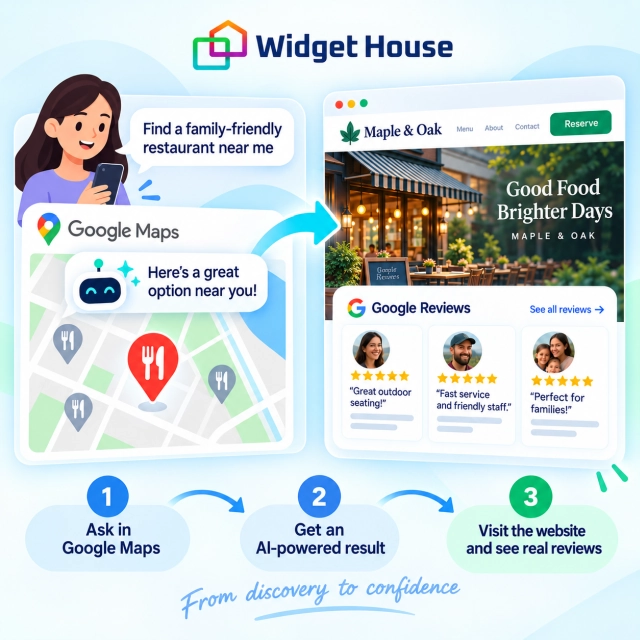
AI-assisted discovery can change what a visitor already knows before arriving on your website.
Imagine someone asks Google Maps for a hotel that is quiet, easy to park at, and suitable for families.
If that hotel appears in the answer alongside information suggesting that customers regularly appreciate those qualities, the visitor may reach the hotel's website with specific expectations already formed.
The website now has a new job:
Confirm the expectation created during discovery.
If customers repeatedly praise quick service, but booking on the website feels confusing, there is a mismatch.
If Maps surfaces information about a restaurant's outdoor seating, but the website barely mentions or shows the patio, useful confirmation is missing.
If reviews regularly describe a contractor as transparent about pricing, but the site gives no explanation of how quotes work, the visitor has to start researching again.
This becomes particularly important when AI increasingly acts as an information layer before the website visit. Pew's 2026 research shows that a majority of U.S. adults already say they read AI-generated search summaries. While that study is not specific to local business discovery, it reinforces a broader change in user behavior: more people are becoming accustomed to receiving an AI-generated interpretation before deciding whether to investigate further.
Source: Pew Research Center: Americans and AI 2026
A Google Reviews widget can help at that verification stage.
How to Display Reviews After AI Discovery
Once an AI-assisted visitor reaches the website, there is no need to reproduce an entire Google Business Profile on every page.
The review section should match the decision being made. A compact trust signal can be enough beside a booking or contact CTA, while a visitor actively comparing the business may benefit from a deeper review section.
You can preview how your own Google Reviews could look on the page with the Widget House Google Reviews builder below. Try different layouts and see how much review proof fits naturally around your content before publishing.
Preview Badge, Carousel, Carousel Photos, Slider, Grid, List, Sidebar, and Wall layouts with your own Google Reviews before choosing what fits the page.
For a detailed breakdown of when to use Badge, Carousel, Carousel Photos, Slider, Grid, List, Sidebar, and Wall, see our Google Reviews Widget Layouts for Every Page guide.
The important point here is consistency: reviews displayed on the website should help verify the reputation the visitor encountered during discovery rather than introduce an entirely different story.
Create Google Reviews WidgetWhat You Can and Can't Control
AI-powered Maps creates an unusual situation for businesses: your reputation matters, but its final presentation is not completely yours to design.
| You can influence | You cannot directly control |
|---|---|
| The customer experience people review | Gemini's exact wording |
| Accuracy of your Google Business Profile | Which themes an AI answer emphasizes |
| The flow of genuine customer feedback | Whether a particular review is surfaced |
| Your responses to customer reviews | How Google summarizes customer sentiment |
| What your website says and shows | Whether every user receives the same answer |
| How reviews are displayed on your website | Which AI-assisted Maps features appear for a particular query |
This distinction prevents businesses from treating Gemini summaries like another piece of metadata that can simply be edited.
They are better understood as one interpretation of a much larger reputation ecosystem: Maps data, Business Profile information, community contributions, individual reviews, user context, and the question being asked.
Final Verdict: AI Summarizes the Reputation, but Customers Still Need Proof
Google Maps is moving from helping users find reviews toward helping them understand what those reviews collectively say. Gemini-powered summaries and Ask Maps can reduce the amount of manual research required to decide whether a business fits a particular need.
But AI does not replace reputation. It depends on the information and customer experiences underneath it. Genuine reviews still build the underlying picture, and the business website still has to confirm the expectations that AI-assisted discovery creates.
What Businesses Should Do Now
The best response is not to create a new “Gemini review optimization” checklist. Focus on improving the quality and consistency of the information customers and Google can already see.
1. Keep your Google Business Profile complete and accurate.
Review your category, services, hours, contact information, location details, attributes, photos, and website link. AI cannot compensate for inaccurate source information.
2. Encourage genuine customers to leave useful reviews.
Do not script their language or tell them which terms to mention. Give customers the opportunity to describe what genuinely stood out about their experience.
3. Pay attention to recurring review themes.
Look beyond the average rating. What do customers repeatedly mention about service, staff, atmosphere, speed, quality, parking, communication, pricing, or specific products?
4. Check how those themes appear across Google Maps.
Review your Place Topics, snippets, customer reviews, and relevant AI-assisted Maps experiences. Remember that what appears can vary by user, query, device, language, and location.
5. Make your website confirm the same strengths.
If customers consistently praise something important, make sure prospective customers can understand and verify it when they visit your site.
6. Bring relevant review proof close to important decisions.
Use customer feedback where it helps answer the visitor's next question—not simply wherever there is empty space on the page.
7. Do not chase artificial “AI review keywords.”
Google has not published a keyword formula for Gemini review summaries. Improving the actual customer experience is a more sustainable strategy than trying to engineer the wording an AI system might prefer.
The larger shift is straightforward:
Reviews are becoming information that customers can ask questions about, not just comments they can scroll through.
Businesses that understand what their customers consistently say-and make the same strengths easy to verify everywhere else-will be better prepared for that change.