
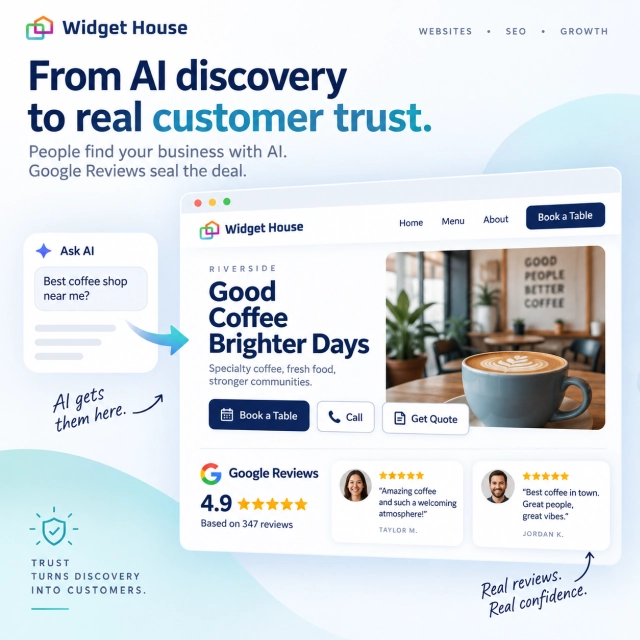
Local search used to have a familiar rhythm: type a query, scan a map pack or list of results, open a few business profiles, read reviews, visit a website, and decide who to contact.
In 2026, that path is becoming more conversational.
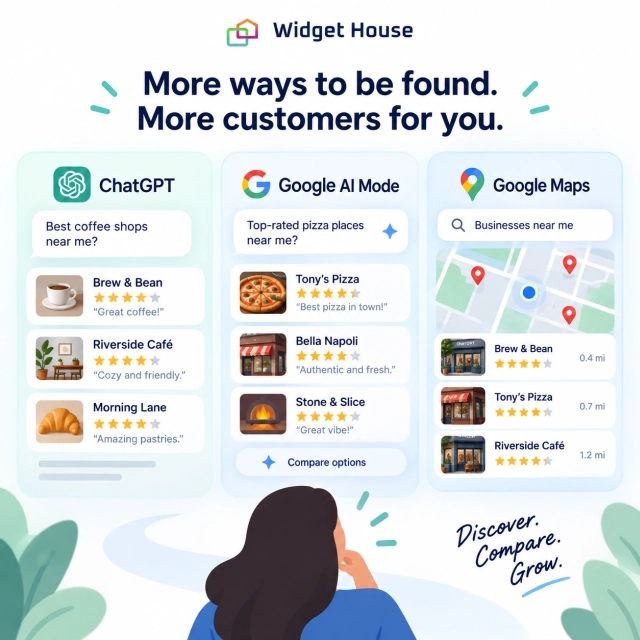
A customer can ask ChatGPT for a nearby restaurant that fits a budget and dietary preference. They can ask Google AI Mode for a salon with strong ratings that is open late. In Google Maps, Gemini can help people explore places and summarize what reviewers say about them.
AI is increasingly helping customers build the shortlist before they ever browse a traditional list of local results.
That does not make Google Reviews less important. It changes where reviews appear and what job they do. Reviews can support classic local visibility on Google, appear directly inside AI-assisted discovery experiences, and provide the trust signal a customer still wants before calling, booking, visiting, or buying.
The important distinction is this: there is no public “AI ranking boost” that a business can unlock by collecting a certain number of reviews or installing a review widget. The opportunity is more practical. Build a strong, consistent local presence, earn genuine reviews, and make that reputation easy to verify when an AI-assisted visitor reaches your website.
What Changed in Local Business Discovery in 2026?
People can now describe the situation they are trying to solve instead of compressing it into a short keyword.
Google says AI Mode has surpassed one billion monthly active users globally. In U.S. usage data published in May 2026, Google also said the average AI Mode query was about three times the length of a traditional Search query, while searches beginning with phrases such as “where to,” “where should I,” and “ideas for” were growing. Google: How AI Mode is changing the way people search in the U.S.
That matters for local businesses because many local decisions are naturally conversational:
- “Where should I take a client for dinner near Union Square if they need gluten-free options?”
- “Find a highly rated HVAC company near me that offers weekend appointments.”
- “Which dentist nearby is good with anxious patients and has recent positive reviews?”
- “I need a dog-friendly hotel with parking within walking distance of downtown.”
Traditional local search is still there. The difference is that AI can interpret multiple requirements, compare options, summarize information, and sometimes help the user take the next action without restarting the search.
Where AI-Assisted Local Discovery Happens Now
The new local journey is spread across several surfaces, and reviews play a different role on each one.
| Surface | What the customer can do | Where reviews fit |
|---|---|---|
| ChatGPT Search | Ask conversational questions using local context, review web-backed results, and in some experiences move from restaurant discovery into reservation options. | Reviews may be part of the web and local information a user verifies, but OpenAI does not publish a formula saying a review count or score guarantees a recommendation. |
| Google AI Mode | Ask detailed questions about places, compare local options, open place cards, call a business, or get directions. | Google says local place cards can show ratings, reviews, opening hours, live busyness, and other place information. |
| Google Maps + Gemini | Ask Maps for ideas, ask follow-up questions about a place, and use AI-generated summaries to understand what people like about it. | Gemini can summarize review themes and answer place questions using Google’s place data and Maps community insights. |
| Google Search & Maps local results | Search directly for nearby businesses, compare profiles, open Maps, call, get directions, or visit the website. | Google says review count and positive ratings can contribute to local prominence and help local ranking. |
ChatGPT: local context can shape the answer
OpenAI says ChatGPT Search can use approximate location, such as a city or region inferred from an IP address, to improve nearby results. On mobile, relevant search responses may also include a map. Restaurant discovery can go further: ChatGPT can show restaurant options and, where supported, reservation availability. OpenAI: Searching the web with ChatGPT
The same OpenAI documentation makes an important point for businesses: search placement is not guaranteed. ChatGPT ranks search results using multiple factors intended to help users find relevant and reliable information.
Google AI Mode: local place cards bring reviews into the AI answer
Google has explicitly connected AI Mode with local business data. For local spots such as restaurants, salons, and stores, Google says place cards can show ratings, reviews, opening hours, and live busyness, with actions such as calling or getting directions. Google: New ways to interact with information in AI Mode
This reduces the distance between “Which business should I consider?” and “What do other customers say about it?”
Google Maps: Gemini is turning reviews into answers
Google Maps now uses Gemini to help people ask for ideas and ask questions about places. Google says users can see AI-assisted summaries of what reviewers like about a place and ask questions such as whether it has outdoor seating or a quiet atmosphere. Google described these features as grounded in information about 250 million places and insights from the Maps community. Google: Gemini in Google Maps
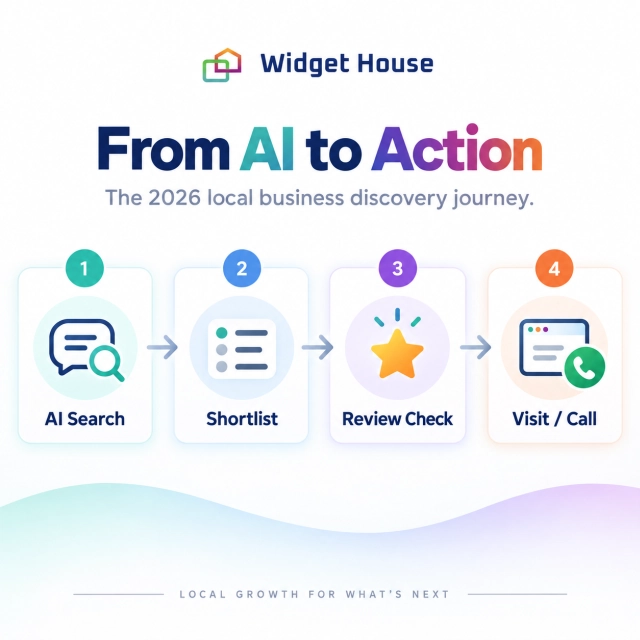
The New Local Customer Journey: Conversation → Shortlist → Verification → Action
AI can compress several search steps into one conversation, but it does not eliminate verification.
| Traditional local journey | AI-assisted local journey |
|---|---|
| Search a short phrase such as “best roofer near me” | Describe the full need: location, timing, service, preferences, and constraints |
| Scan the map pack and directory-style results | Receive a summarized shortlist or place cards |
| Open several profiles and tabs | Ask follow-up questions and narrow the shortlist conversationally |
| Read ratings and individual reviews | See review signals in the discovery layer, then verify the underlying reputation |
| Visit the website, call, or get directions | Call, book, get directions, or visit the website from the AI-assisted experience |
The final action may happen sooner. A customer might book a restaurant from an assistant, call directly from a place card, or get directions without opening the business website.
That makes the moments when a user does visit your website more important. They may arrive with a narrower shortlist, more specific expectations, and less patience for generic marketing claims.
For a closer look at the verification stage, read From AI Recommendations to Website Conversion.
Google Reviews Now Have Two Different Jobs
Reviews can influence classic local visibility on Google and also function as visible evidence inside the customer decision process.
Reviews still matter in traditional Google local search
Google says local results are mainly based on relevance, distance, and prominence. As part of prominence, Google states that having more reviews and positive ratings can help a business’s local ranking. Google Business Profile Help: Tips to improve your local ranking
Reviews are increasingly visible inside AI-assisted discovery
AI Mode place cards can show review information, and Google Maps can summarize review themes with Gemini. That makes reviews part of the evidence customers see while they are narrowing choices.
These two jobs should not be confused.
A review may contribute to classic Google local prominence and may also appear in an AI-assisted place experience. That does not prove that a certain review count, rating, keyword, or website widget causes an AI system to recommend the business.
Learn more about the distinction in Do Google Reviews on Your Website Help SEO?
There Is No Public “AI Ranking Boost” for Reviews
The safest strategy is to optimize the business and customer experience, not reverse-engineer a ranking formula that the platforms have not published.
It is tempting to turn AI search into a checklist:
- get 100 reviews;
- mention the service name inside reviews;
- add a review widget;
- appear higher in ChatGPT or Google AI Mode.
There is no reliable public evidence for that sequence.
OpenAI says ChatGPT Search uses multiple factors intended to help users find relevant, reliable information and that placement is not guaranteed. Google says there are no special AI-search technical requirements beyond the fundamentals needed for Search. Neither platform publishes a rule such as “X reviews equals better AI recommendation visibility.”
What is supported
- Complete and accurate business information helps Google understand and match a local business.
- More reviews and positive ratings can help Google local ranking through prominence.
- Google AI Mode and Maps can show or summarize review information to users.
- Helpful, indexable website content remains important for Google’s AI search features.
What is not supported
- A guaranteed ChatGPT ranking boost from collecting more Google reviews.
- A guaranteed AI Mode placement from installing a Google Reviews widget.
- A public minimum review count required to appear in AI recommendations.
- A special “AI SEO” schema that replaces normal search and local SEO fundamentals.
What Local Businesses Should Optimize for in 2026
The strongest response to AI search is not a new trick. It is a more consistent local presence across the places AI-assisted customers may encounter you.
1. Keep your Google Business Profile complete and accurate
Maintain the basics: category, address or service area, opening hours, phone number, website, services, attributes, photos, and other information that helps customers understand what the business actually offers.
This remains foundational because Google’s local systems rely on relevance, distance, and prominence, and Google’s AI search guidance specifically recommends keeping Business Profile information up to date.
2. Collect genuine customer reviews consistently
Review freshness and breadth help customers see that the business is active and understand recurring strengths or problems.
Authenticity matters. Google reported that the Maps community contributed more than one billion reviews in 2025, while its systems blocked or removed more than 292 million policy-violating reviews. Google Maps: New ways we’re protecting businesses on Maps
The takeaway is not “generate more reviews at any cost.” It is the opposite: build a genuine review history that survives increasingly sophisticated trust and safety systems.
3. Make your website confirm what the discovery layer promised
If the AI recommendation highlights “same-day service,” “quiet atmosphere,” “good with first-time buyers,” or “transparent pricing,” a visitor should be able to verify those ideas quickly on the website.
Strong service pages, location pages, pricing context, FAQs, photos, and customer proof all help reduce the mismatch between the recommendation and the landing experience.
4. Keep important website content readable and indexable
Google’s AI search guidance emphasizes the same fundamentals as regular Search: allow crawling, use internal links, provide a good page experience, keep important information available in text, and make sure structured data matches visible content.
Do not hide the core explanation of your service inside a widget, image, or interactive element that carries all the meaning by itself.
5. Put review proof close to high-intent actions
If an AI-assisted visitor arrives ready to decide, make the trust signal easy to find. A review badge near a booking button or a small set of relevant reviews next to a service CTA can support the decision without forcing the visitor to leave the site and verify the reputation elsewhere.
Where a Google Reviews Widget Fits After AI Discovery
A review widget is most useful as a conversion and trust tool on the website—not as a shortcut to AI visibility.
Once a visitor reaches your page, the widget can bring recognizable Google review proof into the same environment as your offer, pricing, booking form, or contact CTA.
Badge
Useful beside a booking button, contact form, quote CTA, or other high-intent action where the visitor needs quick reassurance.
Carousel
Useful when you want to show several customer experiences in a compact section without taking over the page.
Slider
Useful between service or product sections where reviews can reinforce a specific part of the offer.
Grid
Useful on dedicated review pages, location pages, or deeper decision sections where visitors are actively evaluating the business.
If you are choosing between live Google review proof and hand-picked quotes, compare Google Reviews Widget vs. Manual Testimonials.
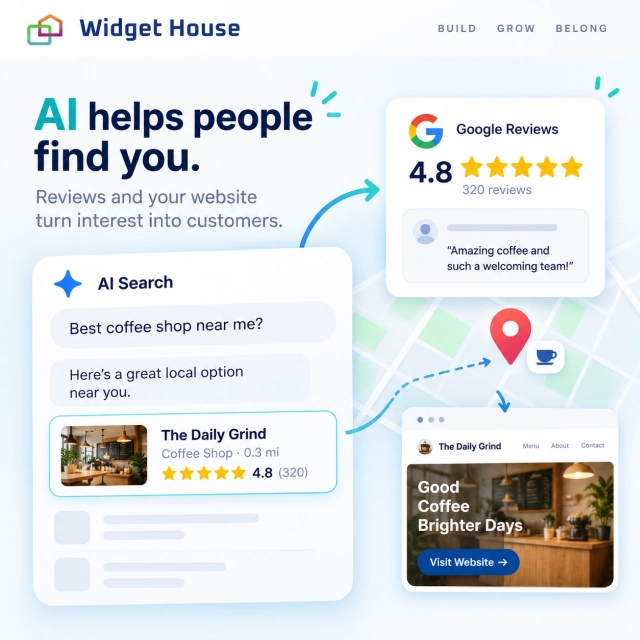
Preview how Google reviews could support the decision on your own website. Choose a layout in the Widget House Google Reviews Widget builder and see how the review proof fits before publishing it.
Measure the Journey, Not Just the Ranking
As discovery fragments across Search, Maps, AI assistants, business profiles, and websites, a single local ranking becomes a less complete measure of performance.
Google says traffic from AI features such as AI Overviews and AI Mode is included in the overall “Web” search type in Search Console rather than presented as a separate SEO category. Google also recommends looking at conversions and on-site engagement in analytics tools. Google Search Central: AI features and your website
For a local business, useful outcome metrics can include:
- calls and click-to-call actions;
- booking or appointment completions;
- direction requests;
- contact-form submissions;
- quote requests;
- store visits where measurable;
- conversion rate on high-intent organic landing pages;
- branded search growth and repeat visits.
AI can change where the journey starts. Your measurement should still focus on whether more qualified customers complete the action that matters.
2026 Local AI Search Checklist
Use this as a practical priority list instead of chasing speculative AI ranking tactics.
- Verify and maintain your Google Business Profile.
- Keep categories, services, hours, location details, and website information accurate.
- Collect genuine customer reviews consistently.
- Respond professionally to positive and negative reviews.
- Make your website clearly explain each major service and location.
- Keep important content crawlable, indexable, and available as text.
- Make the website consistent with what customers see in Search and Maps.
- Use relevant Google review proof near important conversion points.
- Test the website experience on mobile, where many local decisions happen.
- Measure calls, bookings, forms, directions, and other business outcomes—not only rankings.
Final Verdict: AI Changes the Shortlist, Not the Need for Trust
Local business discovery is becoming less like a list of links and more like a guided conversation.
ChatGPT can use local context to help users find nearby options. Google AI Mode can surface rich place cards with ratings and reviews. Google Maps can use Gemini to summarize review themes and answer detailed questions about places.
That means the first stage of the customer journey is changing quickly.
But the fundamentals underneath it are familiar:
- the business needs accurate information;
- the offer needs to match the customer’s intent;
- the reputation needs to be credible;
- the website needs to confirm the recommendation;
- the next action needs to be easy.
A strong Google review profile can support classic local visibility and give customers evidence during AI-assisted discovery. Displaying relevant reviews on the website can then carry that proof into the conversion step.
Do Google Reviews create a guaranteed AI ranking boost?
No.
Do they remain strategically important as local discovery becomes more AI-assisted?
Yes—because the customer still needs proof before choosing.
Frequently Asked Questions
Do Google Reviews help a business rank in ChatGPT?
There is no public rule showing that a specific Google review count or rating directly improves a business’s placement in ChatGPT. OpenAI says ChatGPT Search uses multiple factors to surface relevant and reliable results, and placement is not guaranteed. Reviews can still matter to customers when they verify the businesses an AI assistant suggests.
Does Google AI Mode use ratings and reviews for local businesses?
Google says AI Mode place cards for local spots can display information such as ratings, reviews, opening hours, and live busyness. That means review information can be visible directly inside the AI-assisted discovery experience.
Do more Google reviews improve local Google ranking?
Google says local ranking is mainly based on relevance, distance, and prominence. Review count and positive ratings are among the signals that can contribute to prominence, so more reviews and positive ratings can help local ranking. They do not guarantee a specific position.
Is there a special SEO strategy for Google AI Mode?
Google says there are no additional technical requirements or special optimizations required for AI Overviews or AI Mode. The same fundamentals remain important: crawlability, helpful content, strong page experience, accurate structured data, and current Business Profile information.
Should local businesses display Google Reviews on their websites?
It can be useful when the goal is to bring recognizable customer proof closer to a booking, purchase, quote, or contact decision. A website review widget should be treated as an on-page trust and conversion tool, not as a guaranteed AI ranking tactic.